BKV. Önnek Jar. *
 When I was in Amsterdam, I opted against public
transportation in favor of hoofing it all around, but in Budapest I decided to
invest in a 72-hour public transport ticket. Not that you can’t get around central Budapest on foot—in fact, it’s the best
way to see the city, and I certainly did my fair share of walking. But I wanted
the security of knowing that, in case of emergencies, I could hop on a tram or
a metro that would bring me back to Deak
Ferenc ter (a central metro station close to my hostel) safe and sound. I
was definitely glad of the decision on the afternoon I trekked out to the
“green lungs” of Budapest, City Park; and also on my last night in the city,
when I got stranded on the north end of Margaret Island, a good two-hour walk
from my hostel, as the sun was going down. There are some occasions when you
really just don’t want to walk anymore;
several times in Budapest I reached my limit, and being able to jump on a
streetcar and watch the scenery along the Buda side of the river hurtle by (the
trams in Budapest travel at what feels like breakneck speed compared with those
in Frankfurt) felt like a miracle.
When I was in Amsterdam, I opted against public
transportation in favor of hoofing it all around, but in Budapest I decided to
invest in a 72-hour public transport ticket. Not that you can’t get around central Budapest on foot—in fact, it’s the best
way to see the city, and I certainly did my fair share of walking. But I wanted
the security of knowing that, in case of emergencies, I could hop on a tram or
a metro that would bring me back to Deak
Ferenc ter (a central metro station close to my hostel) safe and sound. I
was definitely glad of the decision on the afternoon I trekked out to the
“green lungs” of Budapest, City Park; and also on my last night in the city,
when I got stranded on the north end of Margaret Island, a good two-hour walk
from my hostel, as the sun was going down. There are some occasions when you
really just don’t want to walk anymore;
several times in Budapest I reached my limit, and being able to jump on a
streetcar and watch the scenery along the Buda side of the river hurtle by (the
trams in Budapest travel at what feels like breakneck speed compared with those
in Frankfurt) felt like a miracle.
It’s actually not as
difficult to decipher metro and tram schedules in a foreign language as I
thought it was going to be: as long as you know which station you want—and
maybe write it down in advance—it’s just a matter of matching. That being said,
it was a much slower process getting from point A to point B in Budapest than
it was in Vienna—which is a much larger city with a much more confusing layout
but where I had the advantage of speaking the language. And you definitely
don’t want to rely on the intercom voice on public transport in Budapest
because the intercom is often A.) drowned out by the noise of the train or B.) broken,
and anyway C.) spoken Magyar doesn’t always sound like what it looks like, and
it’s entirely possible you won’t be able to tell which station the lady is
talking about.
One other thing about Hungarian public transport: Budapest
is super intense about blackriding—
it costs the equivalent of about 60 Euro if you’re caught. BKV posts three or
four super-intimidating-looking security officers at every metro station (Sarah
the Tour Guide warned us at the useful post-tour information session that metro
guards “are not nice people,” but the ones I interacted with seemed all
right—once I showed them my ticket, at least. One even smiled at me.). They
asked to see my ticket no less than four times
in three days. Meaning, if I hadn’t had the ticket, I would have been 180 Euro
in the red.
*I copied these words from the receipt I got along with my
ticket. I have no idea what they mean.
And Speaking of Money
 While Hungary is a
member of the European Union, it is one of the countries whose economy is not
yet strong enough to support the Euro, so the first thing I had to do upon
getting off the train from Vienna was swap out some Euros for Hungarian
florints—at an exchange rate of about 300 florints to one Euro. While
intellectually I understood that being in possession of 30,000 florints did not
mean that by crossing the Hungarian border I had suddenly made my fortune, it
still felt incredibly extravagant to hand over 250 florints for a glass of wine,
4000 florints for a novel, etc. And it’s also sobering to realize, as Sarah the
tour guide pointed out, that while the exchange rate makes Budapest a heaven
for tourists—food and booze and entertainment are all incredibly cheap— it also
makes it a less than excellent place to actually have to make a living.
While Hungary is a
member of the European Union, it is one of the countries whose economy is not
yet strong enough to support the Euro, so the first thing I had to do upon
getting off the train from Vienna was swap out some Euros for Hungarian
florints—at an exchange rate of about 300 florints to one Euro. While
intellectually I understood that being in possession of 30,000 florints did not
mean that by crossing the Hungarian border I had suddenly made my fortune, it
still felt incredibly extravagant to hand over 250 florints for a glass of wine,
4000 florints for a novel, etc. And it’s also sobering to realize, as Sarah the
tour guide pointed out, that while the exchange rate makes Budapest a heaven
for tourists—food and booze and entertainment are all incredibly cheap— it also
makes it a less than excellent place to actually have to make a living.
House of Terror
As I mentioned in my last post, I didn’t spend as much time
visiting museums in Budapest as I did in Amsterdam. While that certainly did
wonders for my wallet, though, I also feel like I gained less of a sense for
the city and its history as a result. In my defense, there is a lot more history to be grasped in
Budapest than in Amsterdam, where the first human settlers don’t even appear
until the double-digit centuries—it’s one of Europe’s youngest cities.
Budapest’s history is much more extensive and, I think you could argue, much
more complex, with the endless series of occupations, the ever-changing borders
of the country, and the city’s status as a meeting-point of east and west.
One museum that I did visit
was the House of Terror on Andrassy Avenue, a swanky up-scale neighborhood that
includes the “Broadway of Budapest.” When I first heard the name House of
Terror, I couldn’t help but think of the ride at Disney World, Tower of Terror.
The Hungarian House of Terror is is nowhere near as much adrenaline-pumping fun
as the Disney ride, though: it’s the former headquarters of both the Hungarian
branch of the Nazi Party, the “Arrow Cross Party,” and the Communist State Security Authority. Today it houses a
museum which details the atrocities committed by both groups—concentration camp
and gulag transportations, illegal surveillance, specious arrests,
interrogations and murders—as well as the experiences of the victims. (As in
Amsterdam and Vienna as well, there’s special attention paid to the rebels and
resistors, as if to say These were the
real Hungarians. We want nothing to do with those other people.)
 |
| Recreation of a communist interrogation room in the House of Terror. |
The museum concludes with an agonizingly slow elevator ride
into the basement of the building, during which a former Communist operative
describes in bone-chilling detail (backed by the same excessively ominous,
emotionally manipulative soundtrack that has followed you through the museum up
to this point) the conditions in which prisoners were kept there, and the
methods by which they were executed. The elevator then releases you into the
basement, which has been restored to look exactly as it did when the Communists
were in power: bare-walled stone cells with bare light bulbs overhead, which
were often kept on day and night to keep the prisoners from sleeping;
interrogation rooms dominated by sinisterly bureaucratic-looking desks; one
chamber containing a gallows which you can only hope is a recreation and not an
actual artifact from the period. The walls of the cells are lined with
photographs of people who were kept there, along with their names and their
dates of birth and death.
The very last room of the museum is also lined with
photographs, names and dates. But in this case the names and faces belong not
to the victims but to the perpetrators, members of the Communist party who were
responsible, whether directly or indirectly,
for the imprisonments, tortures, and murders that took place in the building
over the decades. As I made my way
through this last room, I found myself in the midst of a cluster of older
Hungarian women, who nudged me out of the way in order to crowd close to the
photographs. I couldn’t help but wonder what these women were searching
for—they were of an age where they could very well have been looking for an
ex-boyfriend, a neighbor, a childhood friend—or the person responsible for the
death of any of those people. Then again, they could very well have been
looking for themselves.
In our collective cultural memory, if it’s fair to speak of
such a thing existing, we tend to assume that mass murder ended when the noble
Allies rousted the big, bad Nazis from power in Germany, but the truth is
people have continued to be cruel to one another long after the last
concentration camp was liberated.
Budapest is for
Lovers
I’ve seen a fair amount of PDA in all of the European cities
I’ve been in thus far, including Frankfurt, but Budapest wins the prize by far, both for ubiquity and for intensity. I saw couples making
out on the top of Castle Hill, on the banks of the Danube, on the subway and on the tram, in museums, in
churches, everywhere. There was even
a couple going at it in the HOUSE OF
TERROR, for pity’s sake. And most of these weren’t even teenagers—they were
couples in their upper twenties and older.
It got to the point , after three days of this nonstop barrage
of hormones, where I had to actively repress the urge to shout at random
strangers, “STOP walking around with
your hands in each other’s back pockets. It’s tacky.” Or, “I hate to interrupt
your spit-swapping session, but could you please get out of the way so I can
get off this tram now?” Is PDA this bad in the States, and I just haven’t
noticed? Is what I saw actually
completely within reason, and I’m just hyper-sensitive and over-reacting to it
due to my own breakup woes? Questions to ponder.
Goin’ on Walkabout
No one does world travel quite like the Australians, and I
don’t think anyone does it nearly as well. By far my favorite random-stranger
interaction from the whole two weeks I spent traveling was with David, an
Aussie backpacker in his late thirties/early forties that I met on the free
tour. David, as he explained to me while we waited for the guides to show up
(tourists who showed up after us asked whether we were the guides, I guess because we were both perched on a fountain
the square, which could be interpreted as an official kind of stance) was in
Europe for three months “on walkabout.” “I saw my chance and I just took it,”
he told me, “’Cause you never know if it’ll come along again.” He had no
concrete plans for his trip, as far as how long he was staying in each
location, or even where exactly he
was going. He was mind-blowingly friendly:
as the tour group shuffled between sights, he flitted up and down the
procession, chatting with anybody and everybody who would speak to him, hustling
up to the front every once in a while to ask Sarah a question or three that had
popped into his head.
 |
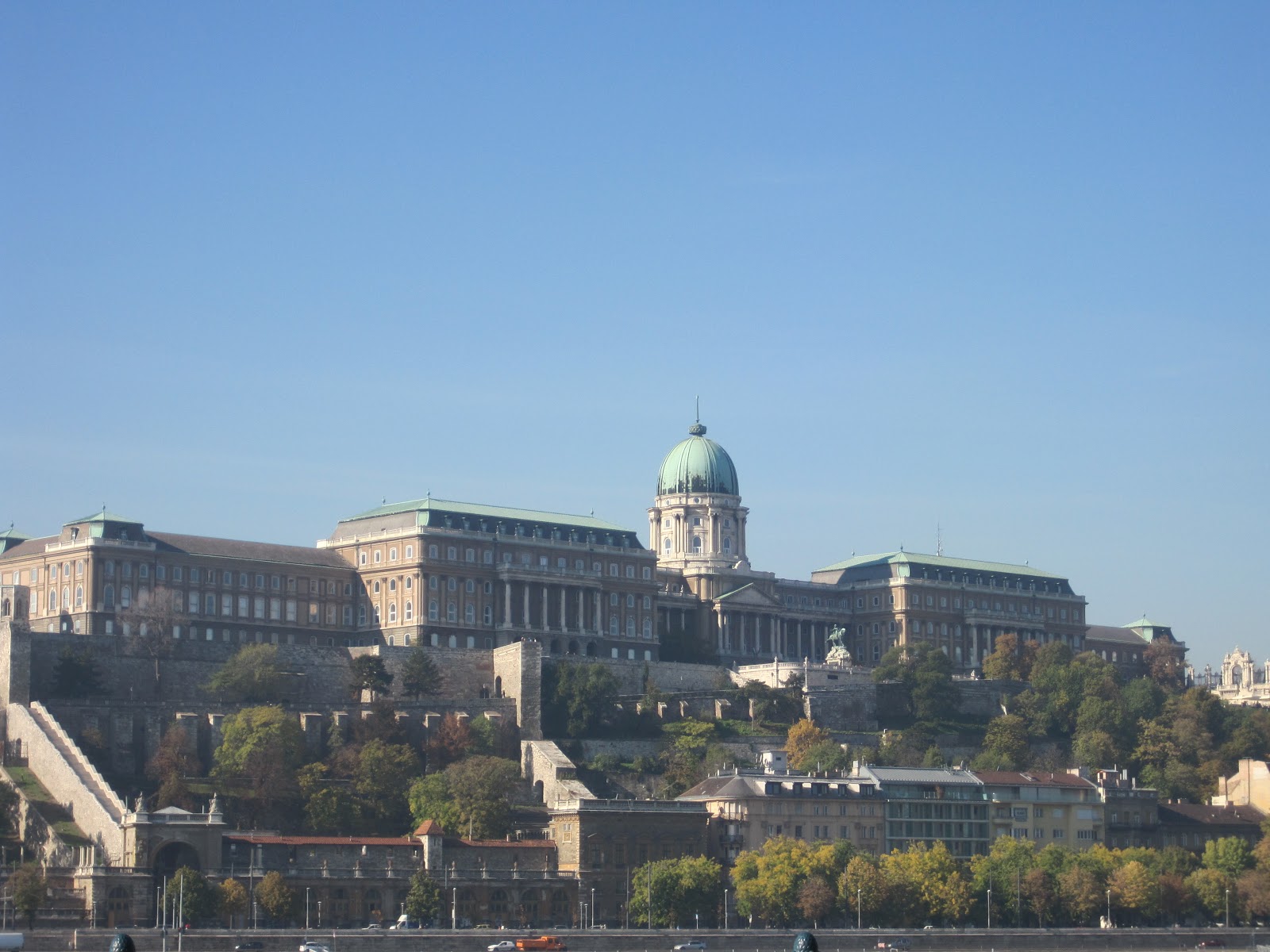
| View of Budapest from atop Gellert Hill |
By the end of the tour, David was unquestionably my new
travel hero. In an instance of small-world kismet, I ran into him again: as I
was climbing up Gellert Hill the next day to get a look at the Liberty Monument
(and, of course, the stunning view of the city), he was on the way down from
doing the same thing. He seemed genuinely thrilled to see me again, asked what
I’d been up to around the city and what I thought about what I’d seen. He told
me was thinking about “shipping off” the next day, maybe heading farther east,
or maybe south, towards the Balkans (a locale a fellow ETA near Frankfurt came
back from Herbstferien raving about
and which I therefore now feel morally bound to visit.) After a few minutes of
pleasant chit-chat, David and I parted ways again—although, as we did, he jokingly told me, "See you in the next city!"
What I love about Australian backpackers is how they seem to
want to genuinely experience the
places they visit. So often tourists have a sort of zombie-like affect: they go
for the sake of having gone, they see for the sake of having seen. Australians,
by contrast, see to see and do to do— it sounds cheesy to say, but they live,
or at least travel, completely in the moment. In the original aboriginal
context, the term “walkabout” has a spiritual connotation: it’s a coming-of-age
journey a young man undertakes on the way to becoming a man. It really seems that Australians have taken this spiritual component of travel, this idea of travel as a transformative experience, to heart. One even hesitates to call them tourists.
A Few Quick Words on
Food

There is one ingredient that you absolutely have to have a taste for if you are going to experience Hungarian cuisine—an element of their culture of which the locals are extremely proud—properly: paprika, Hungarian red gold. Paprika appears in practically every traditional dish, which is why so many of them take on a brownish-red color. In addition to going into the preparation of the dishes, paprika very frequently appears on the table next to the pepper and salt as a condiment. Hungarians love paprika. (Disclaimer: this may be an unfair and reductive cultural stereotype, but whatever. I ate a lot of paprika in Budapest, okay?)
Another piece of Hungarian trivia closely related to food:
apparently Hungary is the world leader in heart attacks and high cholesterol.
When you learn that they traditionally cook their food not in vegetable oil,
not in butter, but in PIG FAT, you
can easily see how that might be a case. It’s actually somewhat
difficult/dangerous to travel in Hungary if you’re a vegetarian, because even
the “vegetable” dishes are cooked up in pig fat. Apparently, Hungarians even
fry pig fat up on its own at eat that. Yum.
 In Amsterdam it was the cheese; now, for Budapest, I’d like
to take a few moments to rhapsodize about the wine. Because the wine I had in
Hungary is without question the most
delicious wine I have ever tasted. Granted, that might not mean much coming
from me, seeing as how my experience with wine is largely limited to the now
two years that I have been over twenty one (ah, how weird, being twenty one!).
But I genuinely cannot imagine wine getting much tastier than this. I bought a
small bottle of tokay at the Great Market Hall—honestly mostly because I
remember “A Decanter of Tokay” as the title of The Golden Compass—and took it back to the hostel with me
(fortunately the communal kitchen was equipped with a bottle opener). The stuff
is liquid gold, I tell you. Sweet
nectar of the heavens. Helplessly under the spell of this astonishing concoction,
I desperately wished to buy a full-size bottle or two to take back to Frankfurt
with me, but I worried, since there were five days in Vienna between me and
home, that packing glass bottles might not be the best life choice in the
world.
In Amsterdam it was the cheese; now, for Budapest, I’d like
to take a few moments to rhapsodize about the wine. Because the wine I had in
Hungary is without question the most
delicious wine I have ever tasted. Granted, that might not mean much coming
from me, seeing as how my experience with wine is largely limited to the now
two years that I have been over twenty one (ah, how weird, being twenty one!).
But I genuinely cannot imagine wine getting much tastier than this. I bought a
small bottle of tokay at the Great Market Hall—honestly mostly because I
remember “A Decanter of Tokay” as the title of The Golden Compass—and took it back to the hostel with me
(fortunately the communal kitchen was equipped with a bottle opener). The stuff
is liquid gold, I tell you. Sweet
nectar of the heavens. Helplessly under the spell of this astonishing concoction,
I desperately wished to buy a full-size bottle or two to take back to Frankfurt
with me, but I worried, since there were five days in Vienna between me and
home, that packing glass bottles might not be the best life choice in the
world.
So, regretfully, I left Hungarian wine in Hungary, as I left
Dutch cheese in the Netherlands. Of course, the Hungarians couldn’t be so greedy as to horde all their wines to themselves. I
need to get my butt to a wine store here in Frankfurt and see what I can turn
up…
 |
And now I give you: sunset over the Buda hills.