Showing posts with label Germany. Show all posts

Wednesday, September 26, 2012

On the Job


As of about 3:00 PM on Monday (or 15 Uhr, as it’s known here) I at last have a concrete Stundenplan for both of my schools. I do not possess adequate words in any language to describe what wonders this knowledge alone has done for my mental health.

At the same time, though, it’s become clear that my job as an English Teaching Assistant is going to be very different from what I thought it was going to be, and I can’t help but be a little disappointed. I know that I’m very fortunate that nothing I’m being asked to do is genuinely outside of my comfort zone—I’ve heard so many horror stories of ETAs who were completely in over their heads at the beginning. But still, it’s hard to let go of the dream of teaching entire classes independently, discussing books and poems and current events that I’m genuinely interested in—especially when I know that there are other ETAs elsewhere who are getting to do exactly that.

As far as what I am actually going to be doing in these various classes, it’s a surprisingly mixed bag, and a lot of it is still up in the air. For myself, I’ve found it helpful to split my various responsibilities into the following categories:

Elsa-Brändström-Schule (or “the Elsa,” as I will probably refer to it from now on)
v Classroom assistant—4te und 2te Klasse (Tues., Wed., and Thurs. 5 hrs.)
v English Enrichment (Tuesday and Thursday, 1 hr.)

Bettinaschule (or “the Bettina,” siehe oben)
v Classroom assistant— 5te Klasse und Q3/Leistungskurs (Monday, 4 hrs.)
v English Conversation—5te and 6te Klasse (Wednesday, 2 hrs.)

For anyone who’s interested (and I promise I won't be offended if you're not), I’ve included more detailed descriptions regarding each of these subcategories of ETA-ship below.


“Classroom assistant”
What this entails depends largely on the level of the class. At the Q3 or Leistungskurs (advanced course) level, the students are preparing to take the Abitur, which is the graduation test that will qualify them for university admittance. The Abi kids already speak and understand English at a level that is, to me, astonishingly sophisticated—seniors in most American high schools certainly don’t speak or read Spanish as well, for example. My job with the Abi kids is to push them farther—to speak more clearly, more readily, and more idiomatically—and also to introduce cultural topics that are relevant and interesting to 17-to-18-year-olds. This part of my job is closest to what I thought going into this that being an ETA was all about, but it actually comprises the smallest portion of my overall class-time. As such, these classes will probably be my “easy” classes, requiring the least preparation and the least mental and spiritual energy. And, I’m not going to lie, they will probably be the classes I most look forward to—to begin with, anyway.

As anyone could probably imagine, the younger grades—Klasse 5 at die Bettina and Klasse 2 and Klasse 4 at the Elsa— are at the opposite end of the spectrum when it comes to language ability. English instruction is obviously at a lot more rudimentary level, consisting mostly of repetitive drills, listening activities, and vocabulary practice. My job at this level, from what I can tell, is just to give the children the opportunity to hear a native speaker, so they know that English is a language that people actually speak in the real world, and not just some tedious task they have to do in school twice a week.

I’m still not completely clear on what my role in the classroom is supposed to be: it’s not very common that ETAs are placed in Grundschule, and there was next to no mention of it at orientation. Frustratingly, the teachers at the Elsa don’t seem to have all that clear of an idea of what they want me to do, either. But I’ve decided to take this complete lack of guidance as an invitation to forge my own path: right now what I think I’d like to do is take small groups out of the class—maybe between five and eight students—and work with them on a small activity, like reading a picture book aloud and having them put the events of the story in order, teaching them a song, or playing some kind of game. Right now I feel like the beginner-level-classroom-assistant portion of my job is going to be the area for which I struggle most to keep up enthusiasm. But at the same time (let’s think positively here) it might be the part that requires the most creativity and resourcefulness.


“English Conversation”
As part of their English instruction, students in the 5th and 6th grades at the Bettina attend a bi-weekly two-hour-long “English conversation” class. From what I can tell, the 5th and 6th grades serve as a crucial transition between Grundschule (primary school) and the upper grades, where students are expected to generate language more independently. The sole purpose of “English Conversation,” then, is to encourage the students to speak English as much as possible. With this goal in mind, the structure of the class is pretty loose and casual— the students need to be comfortable enough that they feel safe speaking in a language that doesn’t come naturally to them and that they may feel incredibly self-conscious about speaking.

This is the class in which I think my prior experience both as an apprentice language teacher at Kenyon and as camp counselor will be most helpful: there will be lots of games, lots of role-playing, and I will need to bring lots of energy and enthusiasm in order to get as much English out of these kids as possible (I know from experience that sometimes getting foreign language learners to actually speak the language can be like pulling teeth.) Additionally, this is the one class where it seems that I am working completely on my own, without an overseeing teacher, although one teacher has offered to discuss my lesson plans with me in advance to make sure they’re on the right track. So I guess, upon further reflection, this portion of my job description is also pretty closely aligned with my original impressions of ETA-hood.


“English Enrichment”
Because Frankfurt is such an international city, there are a fair number of students at the Elsa who have at least one native English-speaking parent, and who therefore speak English as well if not better than they speak German. But the school lacks the resources to provide any alternatives for these students when it comes to English instruction, so they usually end up sitting in the twice-weekly introductory English classes alongside their non-English-speaking classmates. Obviously, this is problematic. Last week, for example, I sat in on a third-grade class that includes a boy whose mother is American. At one point he was corrected by the teacher for saying “Yes he does” instead of “Yes he has,” out of the understandable concern that the different sentence construction might confuse all of his British-English-learning classmates.

So for one hour on Thursdays, I will take native English-speaking students out of the beginning-level English classes and work with them on activities that are more appropriate for their language ability. When I first brought up this idea at the English department meeting at the Elsa on Monday, the teachers with native English speakers in their classes were so enthusiastic that I worried I might end up spending all of my time at the Elsa with the Muttersprachler. But a few of the teachers agreed to switch up what time in the day they teach English, so I will be able to work with kids from multiple classes at the same time and still get plenty of face-time with the English-learning kids during my other five hours at die Elsa. Even though this falls outside of the typical role of “English Teaching Assistant,” I’m really excited about it, in large part because I will have a lot of freedom as to what I decide to do with the kids. My working idea is to bring the American culture element in (a lot of these kids have British parents) by reading some Tall Tales (Pecos Bill, Paul Bunyan, Slue Foot Sue, etc.), and then having the kids prepare a retelling or maybe even their own tall tales, which they would then read aloud or perform as a skit for the rest of their class. That way, the native-speakers can take a sort of leadership role in English-speaking while still being part of their class, and the non-native speakers can receive linguistic and cultural enrichment as well.


“Sonstiges”
There are a few other possibilities for involvement at my school beyond my mandatory twelve-hour commitment: I might lead an AG (Arbeitsgemeinschaft, like after-schoolenrichment in the US) at each school, something hokey and American like Country Line Dancing or Pop Music Club. At the Bettina, I might just hold “office hours” after school once or twice a week, where students can come in and just practice speaking English in a completely casual setting. In connection with the PEAK1 program (Projekt Englisch ab Klasse 1, more on that in a separate entry), I think I’m supposed to collaborate with teachers in Klasse 4 at the Elsa and Klasse 5 at the Bettina to organize some kind of collaborative project between the two schools. But for now, I’m going to focus on my classroom commitments, and make sure I’m completely comfortable with what I’m doing there. 

I’m determined not to let the fact that my job is somewhat different than I expected interfere with how well I do that job. It may not be my dream to be an elementary-school English teacher, but dammit, as long as I am one, I’m going to be the best elementar-school English teacher EVER.

Friday, September 14, 2012

Adventures with Deutsche Bahn


Two days after my arrival in Frankfurt, I encountered the first true challenge of my living-abroad experience: successfully navigating the German train system.

I’m not going to lie: there are certain elements of German life about which I have formed unrealistic and idealized expectations. Train travel is definitely one of these things. It’s not entirely my fault: as an American, I’m heir to the idea of the “romance of the rails,” since travel by train is for the most part something out of an earlier time, associated with the Wild West and soldiers being seen off at the station by their sweethearts and so on. Out of this backgroud, plus stories collected from friends who had been to Europe, I concocted this fairy-tale image of Deutche Bahn: a travel-by-magic public transportation system that enabled one to go anywhere, anytime, almost just by wishing. The reality of Deutsche Bahn is, needless to say, eine ganz andere Sache, as I have now found out from experience.

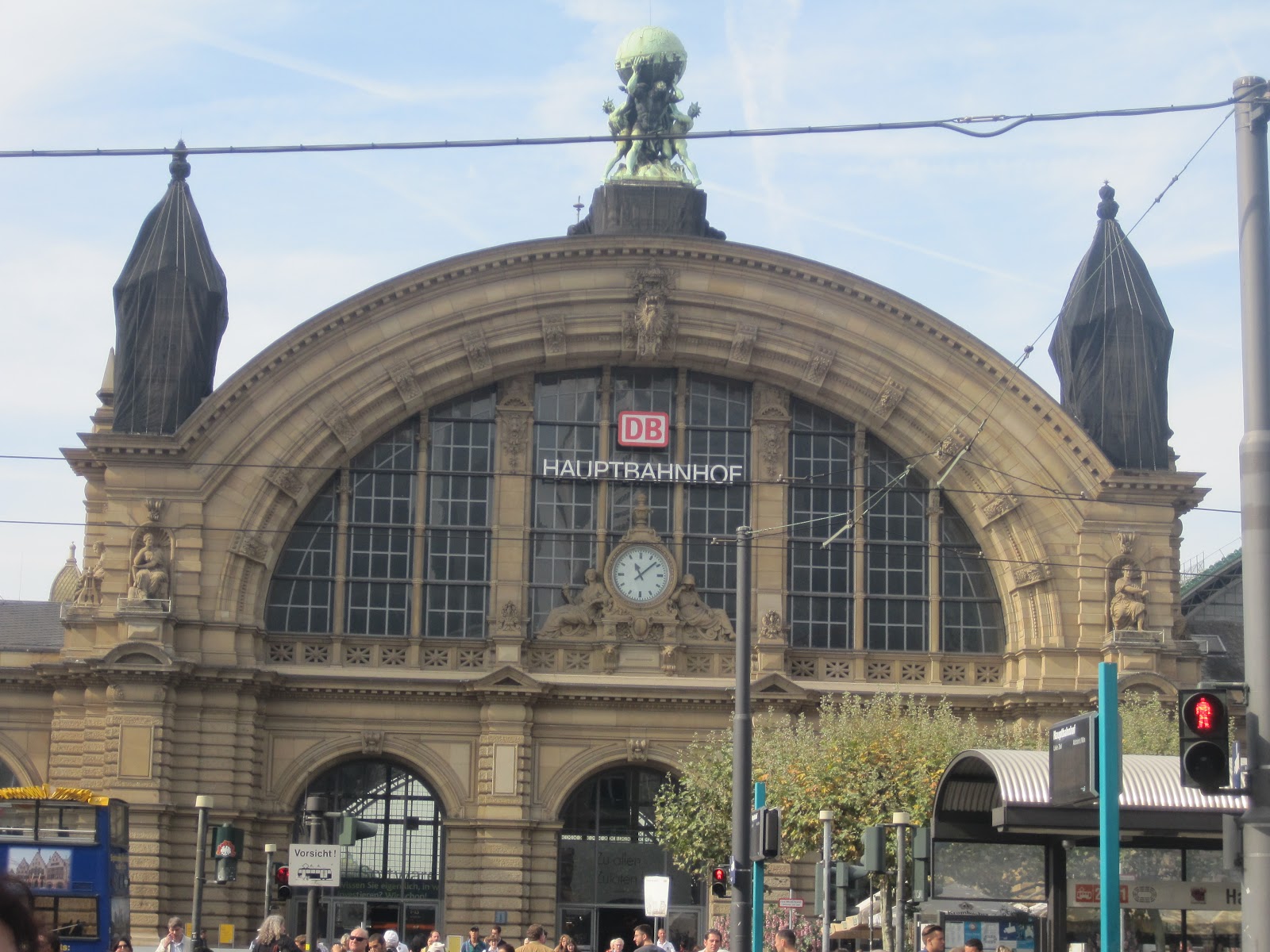
Frankfurt am Main Hauptbahnhof
On Saturday, S took me to the Frankfurt Hauptbahnhof (main train station) to buy my ticket to Köln/Cologne. I bought my ticket from a Fahrkartenautomat, or ticket machine. While part of me feels guilty about this—as a visitor in Germany whose express goal is to improve her German, don’t I have some kind of responsibility to myself, if no one else, to speak with as many Germans in as many different situations as possible?— the opportunity to get my card from a machine, and shield my fragile ego where my language ability is concerned just this once, was too tempting to pass by. And I ended up having to talk to someone anyway, after the machine took my money and did not produce a ticket like it was supposed to.

The ticket I ended up choosing was for an IC (Innercity) train that was scheduled to leave the Frankfurt Hbf. at 11:42 and arrive at the Cologne Hbf at 2:10 (14:10, actually, since they rock military time here, at least for official things like train schedules). I needed to be in the Cologne Hauptbahnhof by 2:30 PM on Monday in order to meet up with the other American ETAs— from Cologne, we would be bussed to the orientation location in Altenberg. It was a snug fit, time-wise, but I chose the cheapest ticket possible, because, even though my travel costs would ultimately be reimbursed by Fulbright, it seemed like the fiscally responsible thing to do. Also I wanted a ticket with no Umstiege, or changes, because I was sure—for reasons that will shortly become clear— that the minute I got off the train at any station other than the Cologne Hbf all hope would be lost.

On Monday, I arrived at the Bahnhof at around 11 o’clock, fairly serene but not wanting to leave anything to chance, and promptly realized that I had no idea what Gleis, or platform, my train was supposed to leave from. Suddenly panicked, I looked up at the Departures board overhead and saw exactly ZERO trains that matched the information I had. This realization was followed by around ten minutes of pacing and panicking before, finally, I got up the nerve to go up to the Information desk and ask an attendant whether the train I thought I was taking did, in fact, exist. In precise but very fast-moving German, he told me that mine was the IC 2024 train (Cologne is only one among many stops, which is why I didn’t see it posted anywhere on the board, although the IC 2024 was there), that it was leaving from Gleis 6, and that it was currently running ten minutes late.

So I made my way to Gleis 6, where I promptly resumed panicking. If the train was running ten minutes late—as a computerized voice reminded me every couple of minutes via loudspeaker that it was—it would get me to Cologne with only ten minutes to spare. Unsure of whether I could find another train to Cologne that would get me there in time, not knowing how to go about exchanging my ticket even if I did, and lacking the time to figure it out, I decided to stick to Gleis 6 and hope there were no further delays.

The train did arrive, finally, at about 11:55. At 12:05 it had still not left the station. In the meantime, I boarded the train, hit several unsuspecting passengers with the baggage that I had thought was so admirably compact and travel-friendly, and sat in a seat that turned out to be someone else’s by reservation. And all the while the minutes ticked by and my chances of getting to Cologne in a timely fashion dwindled away to nothing. Then, at 12:05, a voice came over the PA system to announce that there had been further mechanical difficulties with the train, that it would be underway as soon as possible, and that, if we were going to directly to Cologne or needed to be there before a particular time, we could take a different train, which was departing from the Gleis next door in approximately five minutes. All of this information was delivered very quickly and very indistinctly, over a loudspeaker, and in German, and the combination of these factors caused me to wonder if I had understood correctly, or if the tiny voice in my head telling me to get off the train might just be a manifestation of panic, to obey which would be a catastrophic decision that would destroy any chances I had of even possibly getting to Cologne in time. So I hesitated for a few moments, got off the IC 2024, got back on the IC 2024, asked someone sitting nearby to repeat what the loudspeaker had said about going to Cologne, and then got off the train again—barely in time to jump on the train next door, which was set to arrive at Cologne Hbf. at 13:30, before the doors closed.

My new train was an ICE (Intercity Express) train—a faster model making fewer stops and costing around one-and-a-half times what the CE cost. This last nugget of information convinced me that, having gotten on this train with nothing but my original CE ticket, I was now a stowaway or a joyrider. Consequently I spent the first twenty-five minutes in a cold sweat, sure that, when the conductor came by and asked to see my ticket, my cover would be blown and I would be flung unceremoniously from the train or, at best, deposited at the next stop, which would definitely not be the Cologne Hbf. I started rehearsing my explanation in my head: “Ich war auf einem früheren Zug, aber es gab mechanische Probleme damit und wir wurden davon informiert, dass wir mit diesem Zug fahren durften, wenn wir direct nach Köln gehen wollten…” (“I was on an earlier train, but there were mechanical problems with it, and we were informed that, if we wanted to go directly to Cologne, we could take this train…”) All of which turned out to be unnecessary: the conductor was (to me) astonishingly uninterested in how I came to be on his train. I presented my ticket, he gave it a cursory glance, punched it, and handed it back to me. The whole interaction lasted a total of five seconds, tops. I spent the majority of the remaining train ride asleep, exhausted from a combination of residual jet-lag and the sudden relaxation of extreme stress. As a result, I missed out on most of the scenery between Frankfurt and Cologne, which, according to G, is very nice.

Thus, after much Ärger and Angst, I arrived at the Cologne Hbf in (approximately) one piece. Identifying the Fulbright meeting spot, which had caused me some anxiety the night before, turned out to be a matter of walking into the lobby, looking around, and noticing a clump of people with large suitcases who, upon closer inspection, were all speaking English with American accents. After the exertions of the morning, it was a relief to be able to attach myself to this blob and know that, for the next few days, people who knew what they were doing would be telling me exactly where I needed to 
go and when. And in English, no less.

The return journey from Cologne on Thursday morning was much less eventful. Again, I bought the ticket with a Bahnkartenutomat, and learned from a fellow Fulbrighter that I could in fact print my travel information—Gleis number and all— through the same machine. I had planned to spend a few hours seeing the city before I returned to Frankfurt, but the it was overcast and rainy—far from sight-seeing weather. Also, due to circumstances that I had not foreseen, I found myself bringing a suitcase back to Frankfurt for another Fulbrighter who suddenly had to return to America due to a death in the family. So I ended up taking a 9:50 train that, as it happens, several other Fulbrighters were taking as far as Mainz. We sat together on the train and chatted (in English, of course) about the coming year and our various experiences in Germany before now, and I even got a glimpse of the lauded scenery, including the Lorely, a beautiful rock outcropping on the Rhine with a suitably romantic legend attached; and the picturesque city of Koblenz, which is now definitely on my list of cities to be visited.

After the Mainz stop, it was only half an hour or so before I arrived back in Frankfurt. Between the Frankfurt Airport stop and the Hauptbahnhof, light-headed with the relief of having made it there and back again without any major catastrophes, I found myself in conversation with a couple of Germans, sharing my (unsolicited) impressions of the German train system. “It’s so much less complicated than plane travel,” I pronounced blithely—by which I meant only that there are much fewer formalities and nary a security checkpoint to be seen. The older of the two, a woman with glasses and a sensible German haircut, smiled indulgently. But the younger, an Asian guy about my own age traveling with a guitar case, laughed at me outright. I don’t remember exactly what he said to me, but the gist was, “You really must be new here,” and, “You’ll find out otherwise soon enough.”

I have found out otherwise, of course. One trip and it’s already clear to me that trains run late and break down, stations are fast-paced and hectic, fellow passengers are preoccupied and sometimes impatient. I’ve written in a previous post that airplane travel, when it runs smoothly, is a meditative process. At it’s best, train travel appears to be anything but. Still, it can’t be denied that train travel is incredibly valuable to someone like me, who would like to travel a lot— within Germany as well as outside of it—but doesn’t have access to a car. (Another possibility is mitfahrgelegenheit.de, which is in essence organized hitch-hiking. I don’t know yet if I’ll be brave enough to give that one a try.)

Convenient, but not necessarily efficient—that’s Deutsche Bahn in reality, from what I can tell. Hopefully, the system will become more intuitive for me the more I use it. Perhaps, in the end, I will be one of those seasoned train-travelers who laughs at the naïve newcomer, or maybe tells the story of her first train ride: “I was new to Germany and had to get from Frankfurt to Cologne...” 

Saturday, September 8, 2012

This Episode of Misadventures in Travel is Brought to You By


… Hurricane Isaac, and by the Lufthansa strike.

I will get to Frankfurt sooner or later. It’s just going to be later instead of sooner. (**NOTE** Since writing this post, I have, in fact, arrived in Frankfurt intact AND complete with baggage-- it's a Christmas miracle!) 

As I write this, I’m sitting at Chicago/O’Hare airport gate B17, watching a crew of decidedly not striking Lufthansa employees funnel passengers onto a flight to Frankfurt that I could have been on, had I not been absolutely convinced that the flight was cancelled because of the strike. Instead, I get to wait three more hours—in addition to the two extra hours I already waited in Cincinnati, for the 6:30 PM flight that the very kind and patient United desk agent found for me after the plane that was supposed to get me to O’Hare in time for the 2:30 United flight to Frankfurt went kaputt. And after I insisted (in my defense, having checked the Lufthansa site) that the Lufthansa flight at 3:40 didn’t exist.

It’s all good, though. I’ll just hang out States-side for a few more hours, reading the copy of Bossypants that I picked up back in Cincinnati and enjoying my first quality German eavesdropping/people-watching opportunity—a group of four, all wearing very stylish eye glasses and speaking what sounds to me to be astonishingly correct German. The oldest of the group, a woman with short grey hair, is carrying a newly-purchased, still-in-the-box backyard backgammon set onto the plane. I find the idea of this quartet engaging in some ferocious backyard backgammon somewhere in Germany to be incredibly entertaining.

Anyway, back to my misfortunes. Due to a bout of inclement weather between Cincinnati and Chicago that I can only attribute to the aftermath of Hurricane Isaac, the radar on the plane that was supposed to take off from CVG at 12:20 was KIA—drowned or short-circuited or whatever goes wrong with the fancy navigation equipment in the nose of planes (Encouragingly for those a little nervous about flying, the plane did not nosedive in a fiery inferno of doom as soon as its equipment went haywire on the way to Cincinnati). A jovial fellow-traveler, who from all appearances is a real-life version of George Clooney’s character in Up in the Air, offered the pilot his Garmin, but no dice: we were all going to have to find new flights to wherever it was we were going. Grumble grumble. This is unacceptable. How dare the pilot not be willing to fly back into storm weather basically blind, endangering all of our lives but, gosh darn it, getting us to O’Hare (almost) on time?

I’ve always thought that I’m a pretty good traveler. As it turns out, I’m a pretty good traveler
—as long as everything runs smoothly. The minute something goes wrong, I become anxious, twitchy, prone to bouts of pacing, profanity, and, worst of all, tears. Fortunately, in this particular instance I gave a very good impression of a helpless, bewildered young girl on the verge of an enormous undertaking, and people treated me accordingly: fellow passengers smiled sympathetically, desk attendants offered to escort me to the gate where my new flight to O’Hare would be boarding, the stranded pilot called me “sweetheart.” I hate crying in front of strangers (I won’t pretend I’ve always felt this way; it’s actually a fairly new development), but the truth is it’s not a bad way to get help in the airport. As long as you crack jokes through your tears, don’t curse out the attendants trying to help you, and don’t snot or blotch too noticeably.

One interaction with a particularly sympathetic fellow-traveler I found less enjoyable than others, and less helpful than most. It was with a woman, thirty-five-trying-to-look-twenty-five, with a tumble of dirty-blonde curls and wearing a cross choker around her neck.  I’m at the height of my panic mode, still a good five or six people away from the gate desk. Having completed her own alternative arrangements, the woman comes up to me, rubs my arm sympathetically (anyone who knows me knows that I have a pretty aggressive aversion to unsolicited physical contact), and reminds me that I have my health, and that everything happens for a reason. I don’t know if this makes me unusual, but I don’t find the idea that some higher power wanted me to miss my flight all that comforting—particularly in the moment. I also don’t want to hear that the experience will make me stronger, or that one day I will look back on this and laugh. But I do my best nod-and-smile, thank the woman for her kind words, and agree with her—this is happening for a reason. As she floats away on her cloud, I add to myself, “Because there’s crappy weather between here and O’Hare.”

Anyway, before I know it, I have an alternate connection to Chicago and a brand new Frankfurt flight. And suddenly I’m a good traveler again.

Apart from all of the flight-change hullaballoo, my feelings about the big departure have been oddly muted. I tried to run a diagnostic on my thoughts when I first arrived at my gate, having hugged my parents away at the safety checkpoint and thus begun my great adventure in earnest. But my brain was—and is, still—strangely quiet. I can’t tell if that’s because there’s nothing going on, or because so much is going on that it’s all sort of cancelling out. There’s such a meditative quality to airports, such a sense of suspended motion, that I wouldn’t be surprised if it’s the former.

It’s counterintuitive to say that, I know, given that airports are all about motion, and the amount of hustle and bustle that comes with the territory, and especially in light of the chaos that I’ve just had to wrangle. But when you’re sitting at your gate, or on your plane, and the hustle and bustle are over and there’s nothing to do but wait— wait to board, wait to take off, wait to land, wait to debark—all the motion falls by the wayside. You might even forget that you’re going anywhere at all. This is why I prefer window seats on planes to aisle seats: I like being able to look out and see the earth passing by beneath me, as proof that I’m not just hanging suspended in space.

Do you remember that old gag, mostly from cartoons, where it looks like the character is running past all of this scenery, but then the camera pulls back and you see he’s actually running on a treadmill, and the scenery going past is just a painting on a conveyor belt, looping over and over and over? The gag is played for laughs, but as a kid I always felt sort of bad for the poor guy. But then again, it’s an old puzzle: how do you prove that you’re the one in motion, and not the ground below your feet?

Monday, September 3, 2012

The American Culture Conundrum


My departure to Germany is (finally) mere days away. As I’ve said before, I’ve had more than ample time during the waiting process to think about what living in Germany will be like. One particular thing I’ve been pondering lately is the extent to which I want to stay up-to-date with U.S. happenings while I’m abroad. I’m fortunate enough to have the language proficiency that would enable me, if I so chose, to go “cold turkey” on all things American: current events, politics, pop culture. But, culture junkie that I am, cutting myself off so completely may prove a challenge.

Placing myself on a strict German-only media diet is a tempting proposition, largely because it would help me to advance my language abilities even further, and put me on the fast track toward more instinctive, idiomatic German. The goal is to be able converse with Germans without having them automatically switching to English when they hear me speak. The more diligently I apply myself to reading German news sites, watching German television and reading German books, the more quickly the desired level of fluency is likely to occur. It’s hard to think of any time I might spend perusing the pages of the New York Times or NPR or People.com while in Germany as anything other than time that might have been better spent learning my way around Frankfurt, interacting with native speakers or, at the very least, perusing Die Zeit, FAZ, or Deutsche Welle instead. It seems like cheating, somehow, and a waste of the opportunity I’ve been given.

Of course, there are some aspects of the U.S. cultural landscape that would be easier to swear off than others: politics, for example—I can’t congratulate myself enough on contriving to be out of the country come election day; or celebrity gossip—who’s dating whom, who’s having whose baby, what the Kardashians are doing RIGHT THIS VERY MINUTE. These are things I can surrender with very little regret.

But music, on the other hand. And books. And movies and television… I’m already compiling a list of the movies that are set to be released while I’m in Germany: big ones like The Hobbit, Les Miserables, and the newest James Bond, and smaller ones like Liberal Arts, which was filmed almost entirely at Kenyon. Speaking of Josh Radnor, Ted Mosby is set to finally meet the mother while I’m overseas. There will be new seasons of Modern Family and Grey’s Anatomy (yes, I still watch that schlock). True, many if not most of these things will find their way to Germany eventually, and what isn’t readily available in Germany I can always seek out on the Internet. But that’s exactly why I feel like I have to make a conscious choice about the amount of American culture I retain in my life: if I’m not careful, I could find myself watching only American television and listening to only American music, and in doing that I can’t shake the feeling that I would be doing myself a huge disservice. I keep trying to remind myself that all of these things—the American TV series and movies and albums and books I’m interested in—will still be waiting for me when I come back to the U.S. The chance to have such unlimited access to their German counterparts, however, may only come this once.

There are other obstacles to the all-German-all-the-time scheme, in addition to my own reluctance to give up certain American “comfort foods”. With the internet, it’s a lot harder to go radio silent on U.S. happenings than it was, say, twenty years ago, when my professor had to seek out an ink-and-paper copy of the New York Times every day to get his fix of American news. Now, it’s just a matter of a few mouse clicks. And American news does still seem to be news elsewhere in the world, too: more often than not, there’s an American news story at the top of Die Zeit’s homepage anyway.  Also, my job may require me to stay on top of all things American so I can tell my students, “These are the pop songs/TV shows/movies that are popular in the U.S. right now,” etc. A teacher at the Gymnasium I will be teaching at has already told me that she and the other teachers are looking forward to the opportunity to practice their English with a native speaker. And let’s not forget that Frankfurt has a fairly sizable English-speaking and American-expat contingent, so there are plenty of English-language bars, English-language cinemas, English-language bookstores, and English-language people that it will be almost too easy to seek out.

Perhaps most importantly, it’s still unclear how much homesickness I will have to contend with: I may find myself, in moments of loneliness, turning to American culture as a kind of security blanket. I’m already taking steps to ensure I don’t end up back on American websites out of boredom or habit: I’ve replaced all the English-language bookmarks at the top of my web browser with German-language ones. The theory is that, with time, browsing these German websites will become the same knee-jerk reaction that browsing NPR, Slate, or The Huffington Post is now. But homesickness is a whole different story than boredom, and I can easily imagine myself seeking out the latest Kardashian gossip purely for the sake of a little taste of home.

One site I will definitely not be foregoing, of course, is Facebook, and I imagine I’ll glean a fair amount of news just through the status updates of various friends and acquaintances. Skype, too, will doubtless provide glimpses of the homefront, however much I decide to keep up with on my own.

Aside from it just being the right and responsible thing for me to do as a student of German culture, I like the idea of leaving American culture to its own devices for the next ten-odd months because I like the idea of being able to come back to the U.S.  at the end of that time and look at it with completely fresh eyes. I want, in a sense, to ensure the greatest amount of culture shock possible for myself. One of the benefits of travel, so I’m told, is that it helps you to see where you come from more clearly, and I hope, by stepping away as much as can be managed, to provide myself with the clearest possible vision. 

Thursday, August 30, 2012

Travel and Bildung and Goethe, Oh My!


"Alles, was uns begegnet, läßt Spüren zurück. Alles trägt unmerklich zu unserer Bildung bei." ("Everything we encounter leaves traces behind. Everything contributes imperceptibly to our education.")  J.W. Goethe 

Johann Wolfgang Goethe (1749-1842) has long been viewed as one of Germany’s great cultural heroes. Arguably the greatest: a quintessential intellectual in a country that has historically prided itself on its tradition of writers, philosophers, scientists and musicians. He is, in other words, one of those dead white men that contemporary academic thought teaches us to regard with suspicion. But, in my opinion at least, Goethe has the advantage of being a great deal quirkier than your typical DWM. His rendition of Faust is a sprawling, rambling, unperformable mess—and it also happens to be fantastic. His novel Die Leiden des jungen Werthers (The Sorrows of Young Werther) was fueling teenage angst decades before The Catcher in the Rye. His total body of work is massive, and disregards all boundaries of genre, subject and style.

Goethe also happens to have been a huge fan of travel. He wrote extensively on the subject: the book Italienische Reise (“Italian Journey”) is a travelogue adapted from the journals he kept during his travels in Italy in his mid-thirties. In college, I dismissed this branch of Goethe’s work out of hand. The expoundings of a thirty-something German Romantic on the sublime beauties of the Italian Alps or the curious ways of quaint Italian village-folk seemed entirely irrelevant to my life as a young twenty-something in the twenty-first century. But now, on the verge of my own Deutsche Reise, I’m reevaluating my position and, with the help of that great boon to research, Google, I’ve turned up a couple of ideas worth pondering.

As I’ve said already, Goethe was a huge advocate for the merits of travel. Specifically, he believed strongly in the importance of travel as it pertains to Bildung. Bildung is one of those great German words, like Wissen, Dasein, Weltanschauung, the meaning of which the English translation— in this case, “education”— doesn’t quite capture. Education is in there, certainly, but it shares the stage with a sense of development (if you’re reading this with a solid grasp of basic literature vocabulary, you might remember Bildungsroman, which is translated in English to “novel of development”), and of experience. Just because we English-speakers don’t have a word for this phenomenon doesn’t mean that we don’t recognize it, don’t aspire to it. Thinking about myself and my friends—particularly those who were at Kenyon with me—it seems to me that what we’re all after, at least in part, is Bildung.

According to Goethe, the best opportunities for Bildung are to be found, not in tiny liberal arts colleges on hills in Ohio, but on the road. “Die beste Billdung findet ein gescheiter Mensch auf Reisen,” (“A clever person finds the best education in travel,”) he writes at one point in the novel Wilhelm Meisters Lehrjahre. (I’ve already admitted that my primary research source on this subject has been Google, so I trust you won’t hold it against me when I tell you that I haven’t actually read this novel and therefore don’t know in what context this statement is made, by whom, or to what extent the reader is meant to take it seriously. I’ve graduated, I’m lazy, and I, like most people, have a fondness for snappy capsule-quotes that seem to say something meaningful about Life, the Universe, and Everything.) If I’m interpreting the opinions of Germany’s foremost Geistesmensch correctly, he believes that travel is important because it forces us into contact with different languages and foods, different ways of thinking and of doing things, different value systems and different points of view. In other words: Goethe, off in fuddy-duddy Dead White Man land, advocates travel for much the same reasons as our living, breathing college professors do when they urge us to study abroad. I can almost imagine Professor Goethe at a small liberal arts college today, in a tweed jacket with worn elbows, a rumpled, food-stained shirt and loosened tie, sitting in his book-cluttered office across from a bright-eyed undergrad and saying, “Go. Travel. See. Learn. It’s the best way to become a person.”

So that’s what I intend to do. It’s what programs like Fulbright are for, if you think about it: I’m going to see new things, hear new things, smell and touch and taste new things (in short: five senses, prepare to be rocked). I’m going to talk to new people whose backgrounds and perspectives differ radically from my own and, when it’s all said and done, the theory goes, I’ll a better person for it. While that may sound selfish and not suitably idealistic, I’m certainly not out to achieve world peace by teaching English in upper-class urban Frankfurt, and I think it would be much worse to claim that I was. I guess the idea is that I do ultimately do something with my gebildet-ness (though, like all good German abstracts, Bildung is a Platonic ideal, something not to achieve but to constantly strive toward). Something that—I don’t know—advances human understanding, makes the world a better place. But I’d be kidding myself if I claimed, at twenty-two, to know what that something might be.

Here’s a question to wrap up on, then: what does it mean to be gebildet in our increasingly globalized, ever-more fragmented twenty-first century world? In Goethe’s time, it meant a solid grasp of philosophy and science and language, and an appreciation for the finer things in life, like music and art and literature. But while those are all still noble pursuits, and things that any good Gebildete should try to attain, I think our modern world might call for more emphasis on other ideals, like cultural literacy or tolerance or progressiveness. These are the qualities the world might be in need of, going forward; and while it may not necessarily pay all that well to become gebildet, at least we can rest easy knowing that the world will never be short on idealistic young globe-trotters to follow Goethe's advice: “Die beste Bildung findet ein gescheiter Mensch auf Reisen.” 

Tuesday, August 28, 2012

Ten Days Until Departure...


... so it may seem like this blog is a little premature. But I've been stuck in a maddening sort of  pre-departure holding pattern for a week and a half now, with nothing to do but twiddle my thumbs and obsess over what may or may not have gone wrong/be going wrong /go wrong in the future, and I've decided the only way to reclaim some peace of mind is to stop sulking and start acting like someone who is going to Germany for a year. And what do people who are going to Germany (or anywhere for that matter), and who are my age, do? Why, blog of course!

The waiting is, by far, the worst part. I've been doing my level best to distract myself: with trips to the gym, with flexing my newly found cooking muscles for my family, with HBO-GO and iTunes and the Food Network and NPR. But mostly I skulk around my house in my comfy pants, assembling a mental catalog of all the potential catastrophes that may interfere with my travel plans or, worse, with my grant as a whole-- an important email overlooked, a crucial form gone AWOL, etc. (**BREAKING NEWS** Even as I write this, my mother comes into my room with a package containing the student ID card I need to board my flight and neglected to order until the last possible moment. Phew) Also, I waste excessive amounts of time on Facebook, jealously stalking those friends who have already embarked on the first stage of their post-graduation life, whatever that stage looks like for them; or, worse still, the friends who are, this very day, returning to the reassuring shelter of the tiny liberal arts college on the hill that, with all due pomp and circumstance and a couple of speeches of varying usefulness, kicked me to the curb in May with a piece of paper that supposedly attests to my readiness for what lies ahead. One positive to come from all of this Facebook stalking: it has forced me to come to terms with the hard truth that I had been conveniently ignoring all summer: I am no longer an undergraduate. Ready or not (I mean me) here I come.

Again, I try to distract myself from all of this-- from feeling thoroughly unprepared for real life; from being paralyzed with the fear and uncertainty of moving to a 1.) large city in a 2.) foreign country, both of which are new to me (I didn't go abroad as an undergrad, even though I was a language major, because funds and fortitude were lacking); from mourning the relationship I had no choice but to give up in order to embark on this grand adventure. Mostly, though, my brain feels much like those wild cats in the Cat House down at the Cincinnati Zoo look: when it's not sleeping, which most of the time it is, it's pacing back and forth endlessly along the plate glass that separates it from the rest of the world, able to see what's on the other side but utterly flummoxed as to how to get to it.

Once the ball gets rolling, of course-- once I'm in Germany, once I'm finally doing instead of waiting to do-- most of my current anxieties and neuroses will disappear or, more accurately, be replaced by new ones. Right now I'd welcome those new, more kinetic worries: starting work, finding a place to live, meeting new people, navigating a new city/country/language/culture. These are worries that come with concrete nouns and active verbs attached-- a sense, again, of doing, and of moving forward as opposed to idling. Right now, though, I can't really do much, just watch the very dramatic and decisive life change headed my way come closer and closer. I can't reach out and touch it yet; it's on the other side of that glass which, granted, will disappear soon-- sooner, perhaps, than I'd like it to. Once the safety glass is gone, though, will I have the courage to step out of my accustomed habitat into a larger world that I have, until now, watched only from a comfortable and protected distance? (This is where the cat analogy breaks down: in the case of the animal, the glass is more for the protection of what's outside the glass than what's inside.)

That, I suppose, remains to be seen.